In the spring of 1821, Francis Knifton was born at Coxbench, Derbyshire, the son of Thomas Knifton and his wife Mary (née Slater). He was baptised at St Clement’s Church, Horsley, on 7th May in the same year.
 Francis Knifton was baptised on 7th May 1821.
By 1841, Francis was working as a servant at Stansby House in the neighbouring village of Horsley Woodhouse. This was the home of Charles John Sitwell and his sister Selina Wilmot Sitwell (by 1851 Selina had moved to Spondon and Francis’ older sister Ann was employed by her).
In the summer of 1849, Francis married Hannah Newns. Their marriage was registered at Marylebone, London. The Sitwells presented Francis with a profile portrait of himself, together with an 18th century escritoire, as wedding presents. The portrait survives but the desk is no longer in the family.
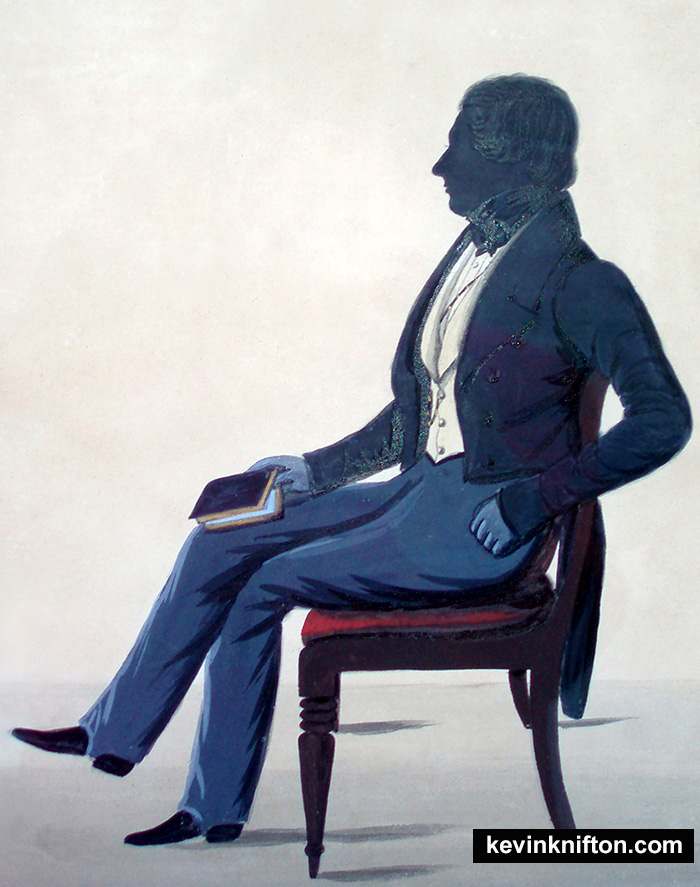 Profile portrait of Francis Knifton
circa 1849
Hannah, the daughter of Thomas and Anne Newns, was born on 31st March 1810 in the village of Ifton Heath, Shropshire, and was baptised at Saint Martin’s Church on 29th April. By 1841, Hannah was working as a servant at Dinthill Hall near Shrewsbury. It is not known how Hannah and Francis met, or why they married in London.
 Hannah Newns was baptised on 29th April 1810
Following their marriage, Francis and Hannah lived at Morton in Derbyshire, where their first child Mary Anne was born towards the end of 1850. The 1851 census records that Francis was farming 88 acres of land, employing 2 labourers and 2 house servants, one of whom was his 11 year old niece Ann Knifton.
Francis and Hannah named their second child Thomas Francis Knifton, who was born in early 1852. He was followed by Elizabeth (‘Lizzie’) in 1853, and Jesse in 1855. All the children were born at Morton.
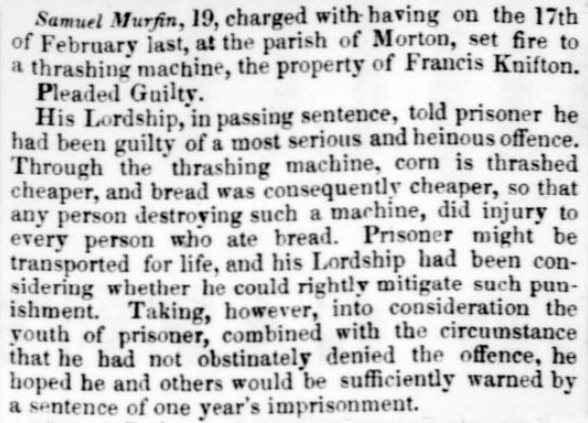
On 17th February 1852, a man named Samuel Murfin, aged 19, set fire to a threshing machine which belonged to Francis. The case was heard at the Crown Court on 11th March.
On 30th May 1854, an inquest was held at the Sitwell Arms, Morton, following the death of a local surgeon. Francis was one of the 12 men on the jury. The surgeon, Mr. Oldham, aged 40, had been struck by lightning while travelling on his gig from Alfreton to Morton the previous evening. The strike had left a mark on his forehead which resembled a gunshot wound, and his clothes from the waist upwards had been burnt from his body. The incident was witnessed by an 8 year old boy who the surgeon had given a lift to, and who had escaped unhurt. The jury concluded that Mr. Oldham had indeed died from the effects of lightning.
By 1855, Francis had opened a butchers shop in Morton, and by 1857 he was also running the Sitwell Arms pub.
 White’s 1857 Directory | Morton, Derbyshire
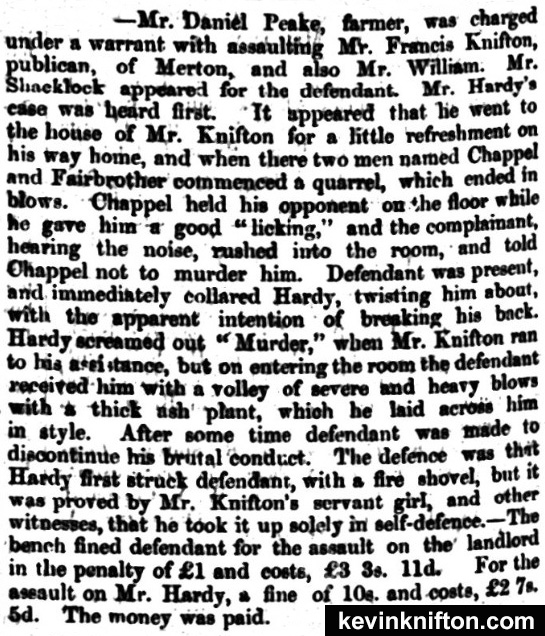
In July 1860 there was a fight between 2 men drinking in the pub, during which Francis was hit several times as he tried to stop the quarrel. The case was heard on 13th July at the Alfreton Petty Session.
On 2nd April 1863 at the Alfreton Petty Sessions, Francis was appointed as an overseer of the poor for Morton Parish for the ensuing year, together with Hugh Hole, a farmer. Being unpaid, this was often a role reluctantly taken, and Francis was not appointed again until 1874.
A month later, on 6th May 1863, Francis and Hannah travelled to Horsley to attend the wedding of his cousin Enoch Knifton at St Clement’s Church. Francis was one of the 4 witnesses to the marriage.
At 3pm on Tuesday, 2nd April 1867, Francis was one of over 200 people who attended the ceremony of laying the foundation stone for a new chapel at Stone Broom. With new collieries having been opened in Morton, houses had been quickly built, creating a new village which was called Stone Broom. A place of worship was required for the new and increasing population. After applying to Henry Hardstaff, a prominent Victorian figure who had risen from being a domestic butler to owner of Hatch Court in Taunton, and who had given the land on which the chapel was to be built, Trustees of the Stone Broom Chapel were appointed. Francis was one of the 12 men named as trustees, and was the only person from Morton. After the ceremony a public meeting was held in a tent and ‘a collection was again made, headed by a £5 note sent by a churchman, J. Holbrook, Esq., of Reading, Berkshire. This handsome contribution was forwarded through Mr. F. Knifton, of Morton.’ 1
In September 1867 at the Alfreton Petty Sessions, a victuallers licence was granted for Morton Parish, then having a population of 594, to Francis Knifton.
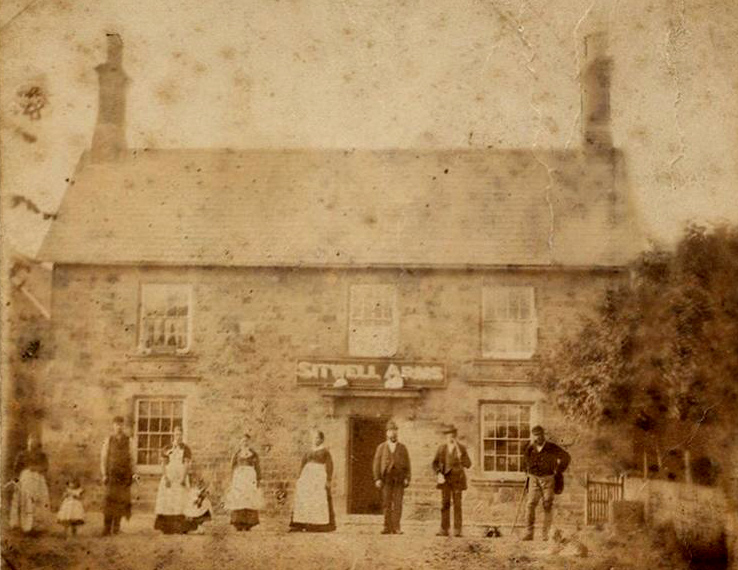 The Sitwell Arms, Morton, circa 1900
On 2nd October 1867, The Derby Mercury reported on the dinner of The Midland Agricultural Society, which took place at 3pm at the George Hotel, Alfreton, probably in the last week of September. It is very likely that Francis was one of the 100 guests who attended this dinner, since one of the ‘special prizes’ awarded ‘To the man servant in husbandry who has boarded and lodged in the house of one master not less than three years’ went to ‘Francis Knifton’s man, Robert Holbrook.’
Francis was still running the Sitwell Arms and working as a butcher and farmer in 1870.
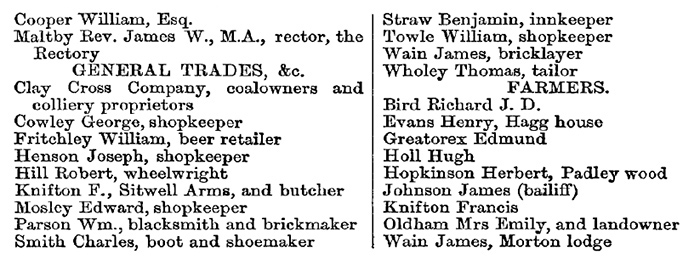 Harrod’s 1870 Directory | Morton, Derbyshire
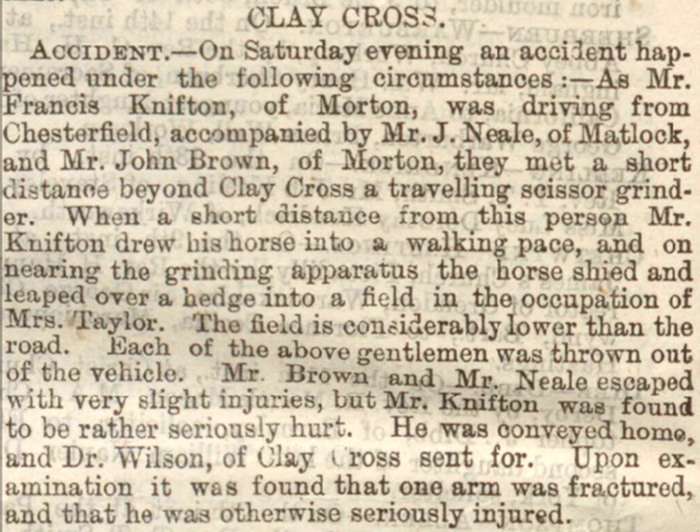
On 11th June 1870 Francis was injured in an accident. He was driving his horse and cart back from Chesterfield, accompanied by 2 other men. As they approached Clay Cross, his horse shied and jumped over a hedge, throwing the passengers into a field. Francis suffered a fractured arm.
Francis’ father Thomas died on 4th November 1870. His Will was proved on 12th December and Francis was the Sole Executor, as his father had wished.
By 1871 Francis was farming 124 acres and running the Sitwell Arms. His sons Thomas Francis and Jesse were working for him on the farm, together with 2 men, including the above mentioned Robert Holbrook. It appears that by this time Hannah had some disability since the entry for her on the 1871 census return notes ‘parralatic’, possibly referring to paralysis.
Francis witnessed the marriage of his daughter Mary Anne when she married Thomas Brown on 25th April 1871.
In April 1874, Francis was again appointed as an overseer of the poor for Morton Parish, together with J. Slaney.
Francis Knifton died on 4th May 1874 aged 54 and was buried on 7th May in the churchyard of Holy Cross Church, Morton. The Administration record for his Estate incorrectly records that he died on 3rd May. The wording on his headstone, which by 2004 was very worn and almost illegible, correctly records that he died on 4th May.

Administration of the effects of Francis, valued at ‘under £600’, was granted to his son Thomas. The documents show that Hannah had ‘duly renounced the Letters of Administration of his personal Estate and Effects’. In July 1874, the license for the Sitwell Arms was transferred to Francis’ son Thomas who continued to run the farm and pub at Morton until 1880.
Hannah Knifton died on 16th September 1877 aged 67 and was interred on 28th September with Francis in Holy Cross Churchyard, Morton. The headstone incorrectly records her age as 66.
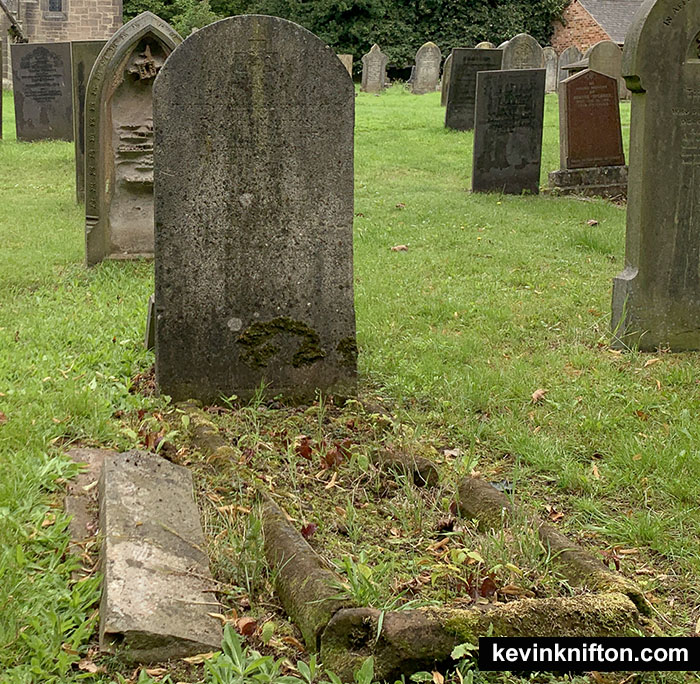 In affectionate remembrance of Francis Knifton, who died May 4th 1874, aged 54 years. Also, Hannah Knifton, wife of the above, who died Sep. 16th 1877, aged 66 years.

Francis Knifton was my first cousin four times removed.
1 The Ripley Advertiser, 3rd April 1867