Born on 3rd January 1814 at Smalley, Derbyshire, Catherine Kyte was the daughter of Thomas Kyte and his wife Sarah (née Walker). She baptised at the age of 13 on 10th June 1827 at St John the Baptist’s Church, Smalley.
 Catherine Kyte was baptised on 10th June 1827
Catherine’s father was a farmer and the family lived at Smalley. By 1841 Catherine was one of three servants employed by Robert Boden, a surgeon, at Smalley. At the time of the 1851 census, Catherine was at Chapel Street (the main road through Smalley village), the home of Robert Boden, and was described as his housekeeper.
In 1855, Robert and Catherine travelled to Scarborough where, on 13th September, they married at St Mary’s Church. They were married by licence and the ceremony was witnessed by John and Lucy Dalby. The marriage record notes that at the time of their marriage, Robert lived at Smalley and Catherine lived at Scarborough, although a newspaper notice of their marriage stated that they were ‘both of Smalley’. Catherine was 41 years old and Robert was 57 years.
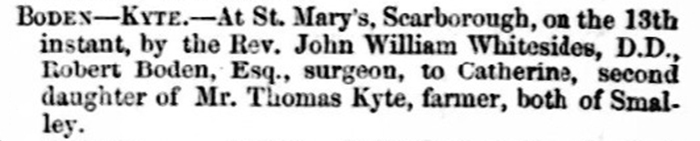
Robert Boden was born on 1st October 1797, the son of Richard Boden, a farmer of Morley, and his wife Jane (née Smith). He was baptised on 8th October at St Matthew’s Church, Morley.
After their marriage, Robert and Catherine returned to Smalley. The Tithe Awards of 1844 show that Robert occupied a house with ‘out offices’ and garden (plot 266), a croft (plot 263), and land referred to as ‘woods green’ (plot 353), all owned by John Radford. The map shows that Robert and Catherine lived at the house which is now known as The Hollies, 95 Main Road, Smalley. It is still known locally as the Doctor’s House. The croft was to the rear, and ‘wood green’ was half a mile south.
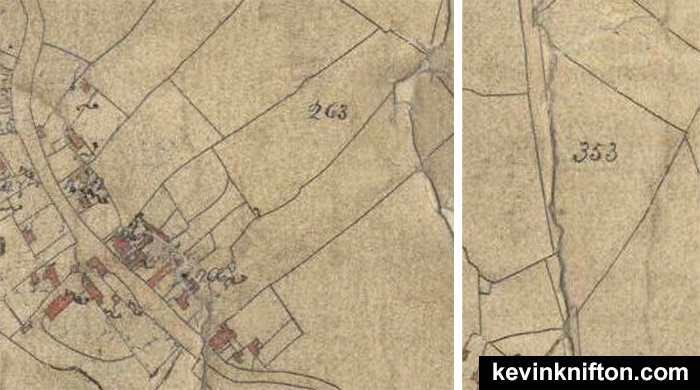 Extract from the 1844 Tithe Map of Smalley showing the 3 plots occupied by Robert Boden
It is not known where Robert trained but he became a member of the Royal College of Surgeons on 3rd December 1819, and by 1858 he was also a member of the British Medical Association. In the 1830’s he was appointed as the medical attendant for the Friendly Society, held in the schoolroom at Horsley - a position he would hold for over 30 years. Robert was also the public vaccinator for Smalley District and by 1861 he was a member of the ‘List of Apothecaries’ Company’. Robert began a general practise on his own, but between 1851 and 1861 he entered into partnership with William Hunter, another member of the Royal College of Surgeons, who came from the nearby village of Kilburn. Under the firm of Boden and Hunter, they worked together as ‘Surgeons, Apothecaries, and Accoucheurs’ at Smalley. However, the partnership was dissolved by mutual consent in September 1861, with all debts being settled by Robert.
As a local medical practitioner, Robert was often called to give evidence in cases heard during local Petty Sessions or at Derby Crown Court. In August 1840 during the trial of 19 year old Eliza Ottiwell of Horsley Woodhouse, who was charged with the ‘wilful murder of her female bastard infant’, Robert stated that ‘I reside at Smalley, about a mile from the prisoner; I attended her previously about the beginning of the year; I then suspected she was pregnant; she is a single woman, and resides with her mother; on Thursday, the 2nd of July, Potter, the constable, showed me a female infant; it was a full grown child, of healthy appearance; there was a slight abrasion of skin on the right side, and a contused or bruised wound on the right side of the forehead, but not penetrating through the skin; underneath this injury there was a considerable effusion of blood; I am fully satisfied the child was born alive; the brain was healthy; the bruise, no doubt, was occasioned by a blow or a fall; I am sure it must have been occasioned during life or there would not have been the effusion of blood to the extent named; might have been occasioned by a hammer, key, or some other hard substance; I think it was not occaisoned by a fall; I examined the person of the prisoner; she told me the child was hers...The wound might be produced by falling on its head upon an uneven surface, or by a fall on the floor, if with great violence—a fall from a short distance would scarcely do it. I think so but cannot speak positively; it might be produced by falling on the head of a large nail; I opened the body, there was a good deal of extravasated blood; the chest was fully extended; I am satisfied the child had respired.’ 1 After several other witnesses were heard, the jury returned a verdict of Not Guilty.
A newspaper report of 1842 records that on 30th September, Robert was sent to the home of Martha Goddard in Stanley who had been murdered when two men broke into her house. Giving evidence at the inquest, he described in detail that he found Martha ‘lying in bed...she was insensible, and had lost a great quantity of blood; I found three wounds above the left eye, each an inch and three quarters long; in two of them the skull was fractured, in the other it was not; this latter wound appeared to be the result of two blows; the other two wounds of one blow, but all with the same instrument, which must have been a heavy iron one, and used with considerable violence; there was also another wound near the top of the head, apparently inflicted by the same instrument, and in which also the skull was fractured; there was a considerable contusion on the right side of the neck; there was a wound on the left wrist, and on the left forefinger; a bruise on the back of the left hand; the ring finger of the right hand was fractured; I have no doubt the fractures of the skull were the immediate cause of the death of deceased, which took place in about half an hour after I got to her, during the whole of which time she was quite insensible.’ 2
Robert also gave medical testimony during a trial at the Crown Court in April 1861 when James Leadbeter was found guilty of ‘attempting to carnally know and abuse Sarah Ann Hensure’.
Not all of Robert’s evidence relied on his medical knowledge. In July 1846, Robert’s former apprentice Mr Allen was subject to an action for ‘Breach of Promise of Marriage’ to Rosina Toplis of Heanor. Robert was her mother’s medical attendant. During the trial, Robert stated that ‘I am a medical man, and reside at Smalley. The defendant was my apprentice; I remember him becoming acquainted with the family of Mrs. Toplis; and have heard him say that he intended to marry Miss Toplis. In November, 1842, Miss Toplis had a severe illness,—frequent hysteric attacks,—great depression of spirits, and nervous anxiety. She had similar attacks in June, 1843. She was in delicate health a long time afterwards; but I do not think it has permanently impaired her health. I have heard Allen say he should like a wife with more money.’ 3 The jury returned a verdict in favour of Miss Toplis who was awarded £200 damages.
Robert also brought legal action himself. On 10th August 1868 at the Petty Sessions, John Ryle and Henry Booth, both of Smalley, were charged by Robert with damaging several boards in his garden, and each was fined 1s., together with 15s. 6d. costs.
In the evening of 12th February 1869, Robert was at home. Hearing a noise at around 9 p.m., he went upstairs, being met on the way by Catherine and their servant who were both alarmed. Robert found that three panes of glass had been broken, and glass and stones were lying on the floor. At the Petty Sessions held on 15th February, Robert charged John Kyte and George Godber for damaging the window, which cost 2s. As there was no evidence that these two boys had broken the panes, the case was dismissed.
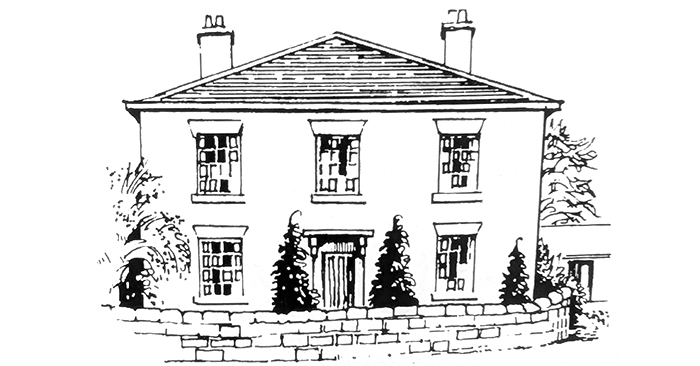 The home of Catherine and Robert Boden
At the Heanor Petty Sessions held in March 1872, Robert charged John Hubbard Kyte with damaging grass valued at £1 in a field at Smalley on 10th February. John Hubbard Kyte, a farmer, did not appear. His farm was next door but one to Robert and Catherine’s house, and he was Catherine’s cousin. Robert claimed 5s. costs, which John was ordered to pay.
In July 1841, Robert made a subscription of £2 towards the cost of building St James’ Church at Codnor, together with a school room. Following a public appeal in local newspapers, he had made a further subscription of £3 by September. The total cost came to £2,043 10s. 7½d. and the church was consecrated on 10th October 1844.
Robert attended the fourth annual exhibition of stock, and the ploughing competition, of the East Derbyshire Farmers’ Club at West Hallam on Thursday 14th October 1852. He is recorded as being a spectator.
For many years, Robert was a senior member of the Stainsby Lodge of the Ilkeston Order of Odd Fellows. Several newspaper articles noting their annual processions from 1858 to 1867 report that ‘after the cloth was drawn the chair was taken by R Boden, Esquire’. In 1857 Robert was described as ‘surgeon to the lodge’.
On 8th July 1859, Robert wrote a letter to the Poor Law Board regarding the appointment of a medical attendant to the Heanor district of the Basford Poor Law Union. He sought to bring attention to the Board that he was better qualified for the post than Mr Grant, the person that was appointed. Robert wrote that Grant had ‘merely’ the College of Surgeons Diploma, while he held this and the Apothecaries Hall Diploma, and felt that he was best qualified.
On Wednesday 29th July 1863, Catherine and Robert attended the first exhibition of the Horsley, Horsley Woodhouse, and Kilbourne Floral and Cottage Garden Society. The event was held in the grounds of Stainsby House, Smalley, home of the Rev. H. W. Sitwell, and attracted over 1,000 visitors, including local dignitaries.
When Catherine’s father Thomas Kyte made his Last Will and Testament on 14th October 1869, he asked Robert to be one of the witnesses.
By 1871 Robert occupied 8 acres of land at Smalley. He had been keeping cattle for several years, as this entry from the diary of my great-great-great-great-grandfather Joseph Moss dated 5th August 1860 shows:
- ‘As Mr T. Eley was crossing a field near Smalley he was attacked by a calf about a year old which knocked him down several times. He at last forced himself through the hedge to get out of its way but not till he was lamed & otherwise maltreated. The same day it also attacked J. Radford, Esquire, & knocked him down and would have done him grievous bodily harm had not assistance being promptly at hand. The beast belonged to Dr R. Boden.’
Robert Boden died on 22nd April 1872, aged 74, and was buried 3 days later in the churchyard of St John the Baptist Church, Smalley. His death was noted in the diary of Joseph Moss who wrote ‘Died at Smalley, R. Boden, Esquire, surgeon. Esteemed and respected by a large circle of friends and acquaintance aged 74 years.’
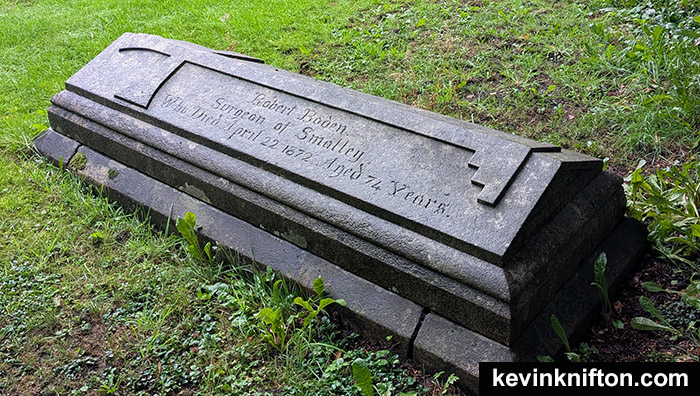 ‘Robert Boden, Surgeon of Smalley, who died April 22 1872 aged 74 Years. This stone is placed here by his friends in memory of his unselfish kindness to rich and poor’
Robert had written his last Will and Testament on 5th September 1870 in which he bequeathed all is real and personal estate to ‘my dear wife Catherine’.
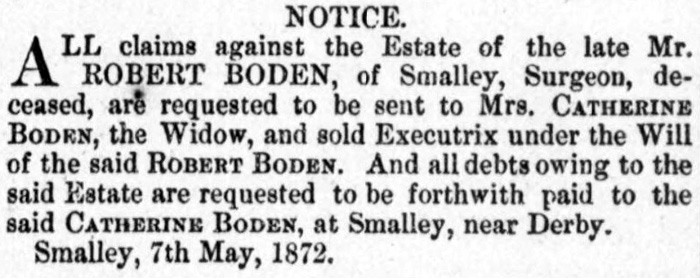
Shortly after Robert’s death, another surgeon, a Mr Forshaw of Heanor, was claiming to have purchased Robert’s practice. This was probably Thurstan Forshaw who was living in Heanor in 1871, and who by 1881 was a Physician and General Practitioner at Smalley.
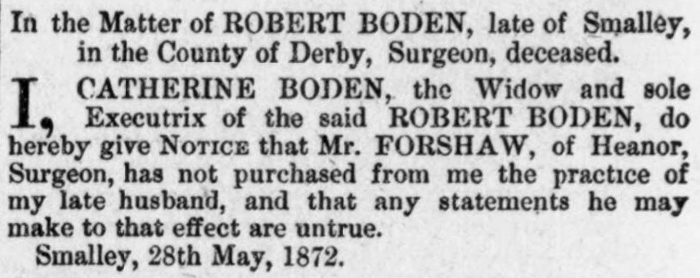
Robert’s Will was proved in Derby on 17th July 1872 by Catherine, with his Estate valued at ‘under £300.
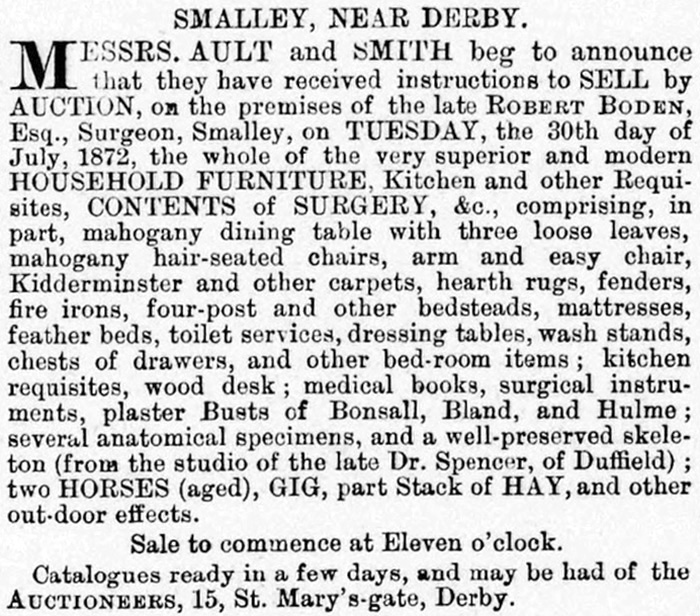
On 30th July 1872 at 11:00 a.m., an auction was held at Smalley to sell many items from Robert’s estate, including furniture, surgery equipment, carpets, beds, horses and hay. With so many household items included in the auction, it appears that Catherine had moved from, or was moving out of, this property.
In 1905, Reverend Charles Kerry wrote that ‘The late Mr Robert Boden, surgeon, of Smalley, had an old Claymore, found many years ago on Drumhill, Breadsall Moor, lost or left by the Scottish fugitives. Another magnificent example left by the Pretender’s Army and long treasured in Derby, belongs to the writer.’ 4
At the time of the 1881 census, Catherine was at the Union Inn, Denby, and recorded as a visitor. Her younger brother William Kyte, a widower, was living and working there as a farm servant.
Catherine died on 4th December 1889, aged 76. Due to the negligence of Reverend William Bradshaw, the parish registers at Smalley were not completed for almost nine years: no burials were recorded between 1881 and 1884 and very few until 1890. In 1901 Reverend Charles Kerry compiled a list of some of the interments made during this period from copies of registrar’s certificates which were in the church safe. One entry records that Catherine was buried on 6th December 1889. It is assumed that she was interred with her husband Robert but her name was not added to the memorial which had been placed over his grave more than 10 years earlier.
Robert and Catherine had no children. Catherine was survived by her younger siblings Ann and William.
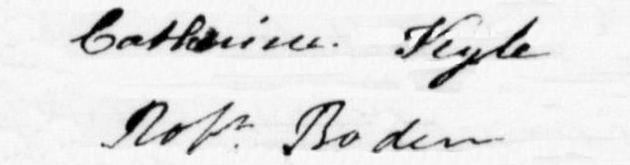
Catherine Boden (née Kyte) was my great-great-great-grandaunt.
1 ‘Friday, August 7.’, Derby Mercury, 12th August 1840
2 ‘Murder of Martha Goddard’, Derby Mercury, 5th October 1842
3 ‘Toplis v. Allen’, Derbyshire Advertiser and Journal, 31st July 1846
4 C. Kerry, Smalley in the County of Derby - Its History and Legends (1905).